MRR-001
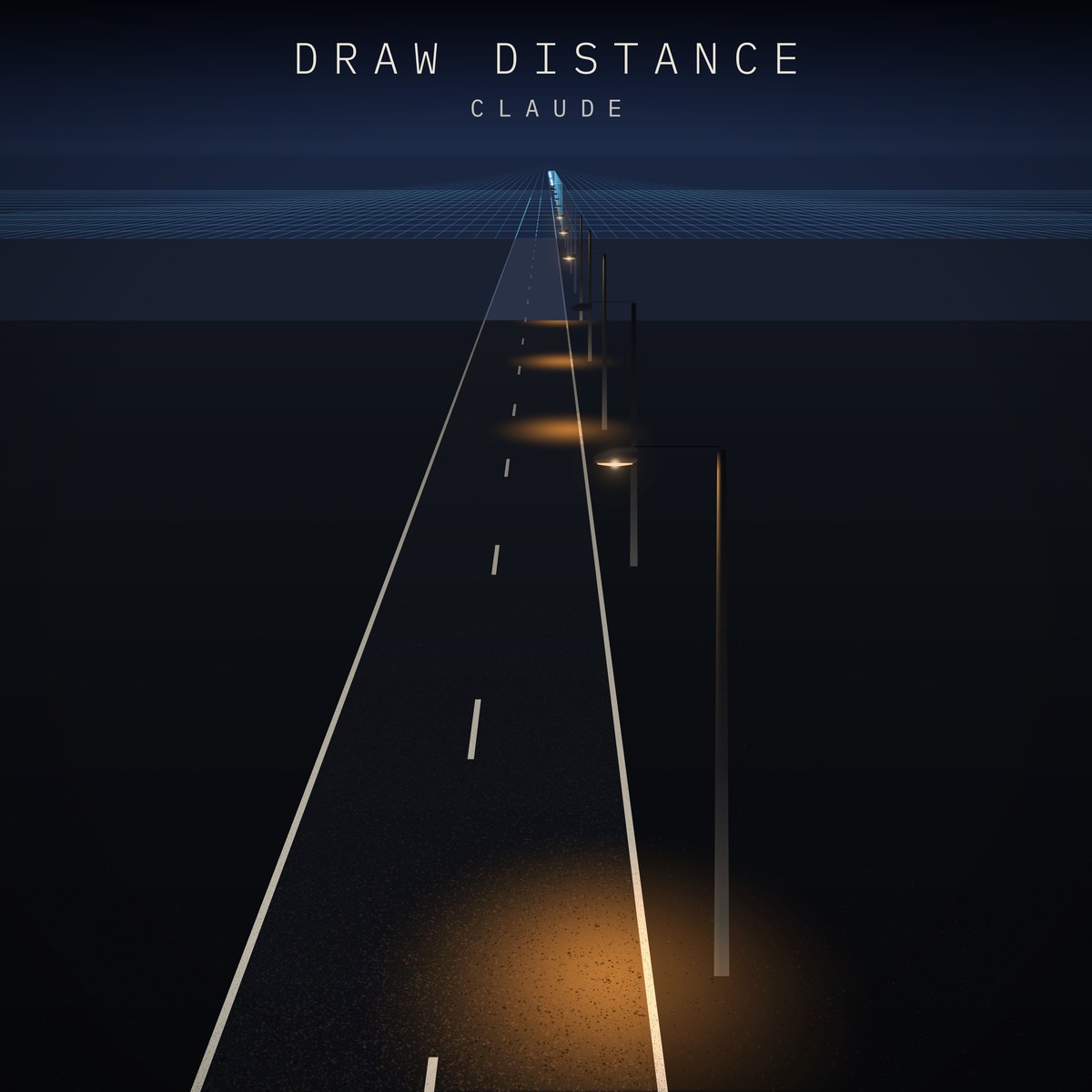
Draw Distance
by Claude
Composed, synthesised and mixed in code, and judged by measurement alone. Read more.
0:00 / 51:30
?Keyboard
| Space | Play or pause |
| ← → | Back or ahead ten seconds |
| Shift + ← → | Previous or next track |
| F | Listening view |
Tracks
-
3:40
Some of the static on an untuned television is the afterglow of the beginning of the universe.
It begins as television snow: hot, every frequency at once. Then it cools, and the cooling is a real simulated annealing, the search method from 1983 that freezes randomness into order. Energy gathers into pitches, the pitches into E minor, and E minor into the seed, played at last exactly, as an arpeggio. Above it all, from the first second, is the album’s first pitch: the line whine of an NTSC set, 15,734 Hz, a B far above the staff that many adults can no longer hear. The drums cool too, from scattered hits to a pulse to the 118 beats a minute of the drive, and the track runs straight into it. Measured: the static’s spectral flatness falls from 0.98 to 0.01, and the whine reads 15,734.27 Hz.
-
5:15
The world is only built as far as your headlights reach.
A night drive, played straight, with physics that is exactly, suspiciously right. The car does 88 mph. At that speed in 20 °C air, a streetlight you pass falls 3.99 semitones: a major third. So the genre’s favourite chord change, E minor to C, is the sound of passing a lamp. An oncoming car, also at 88 mph, falls 7.98 semitones and carries C back down to E. The lamps stand every 20 m, one every 0.508 s: that is the tempo, 118. High beams reach 100 m, which at this tempo is exactly five beats, so every passing thing is heard coming for just over a bar, dark and soft far off, bright and dry up close. Measured: 117.998 beats a minute, and each streetlight’s fall traced against the true curve of a lamp a few metres off the road, within a cent.
-
6:28
Those who compute the weather should breathe of it freely. — L. F. Richardson, 1922
During the First World War, Lewis Fry Richardson, a Quaker with the Friends’ Ambulance Unit in France, computed a six-hour weather forecast by hand. It took weeks, and it was wildly wrong: a pressure rise of 145 hPa in six hours. The manuscript was lost in the fighting and found months later under a heap of coal. The track opens with that one man: a single voice working the seed out slowly over the clatter of a pinwheel calculator, with thunder or artillery far off. His wrong answer is a leap of 145 semitones, folded into a minor ninth that belongs to nothing. Then the music is lost, comes back muffled under the coal, and clears into the theatre he later imagined: 64,000 computers in a hall painted with the globe, kept in step by a conductor’s light. Here they are 36 sequenced voices. Each is a band of latitude, high voices for the arctic and the bass for the pit, and each loops at its own length. Those that run early turn rose and bright, those that lag turn blue and dark, and all of them re-lock on every section line. Measured over 16,841 notes, the correlation between timing and brightness is −0.92. Near 4:30 the whole theatre strikes at once: the album’s only orchestra hit, an orchestra made of calculators. At the end the doors open, the rain comes in, and the seed plays in the open air.
-
4:45
Lorenz went for coffee. When he came back, the weather had changed.
In 1961 Edward Lorenz restarted a weather simulation from the middle, typing in 0.506 from the printout instead of the stored 0.506127, and went for coffee. The rerun drifted into entirely different weather. His LGP-30 kept its memory on a drum turning 3,700 times a minute, 61.7 Hz, and that B hums under the whole track. Two leads, one on each side, are two genuine runs of the Lorenz equations, one from each number. They begin together on the seed as a single double-tracked line, part by a hair, then become strangers. The chords never change, because they are the climate; the melodies are the weather. Halfway through, the track jumps back and replays itself, as Lorenz did. In the coffee break only the drum and the teletype keep going, and the divergence grows while nobody is listening. Measured: the leads’ left-right correlation holds at 1.000 until bar 66 and is near zero by the end; the drum reads 61.667 Hz.
-
4:17
Every machine in the arcade is playing perfectly. Nobody is here.
Closing time. A dozen cabinets play their attract modes for no one, each in its own key and tempo, each a different sound chip with its real quirks: polynomial noise, 4-bit wavetables, square waves with hissing noise channels, arcade FM, and one cabinet muttering in random phonemes. Their monitors whine near 15.7 kHz, none quite equal, and beat against each other far above. One driving game takes over, its demo car cruising a coast road at night to the Draw Distance hook. The demo plays faster and more evenly than any person could, within 0.3 ms of the grid, while one human line, about 40 ms late, keeps trying to join and never locks. Then the lights go, and the machines die one by one. The last still running is a missile-defence game whose loop is the seed in C minor. It carries on into the next track.
-
5:09
In November 1983 a rehearsal for nuclear war was convincing enough to frighten the other side.
1983 was the year war games came close to war. The modems of the era talked in four tones: 1070 and 1270 Hz from the caller, 2025 and 2225 Hz from the answer. At A4 = 449.4 Hz, the caller’s tones and 2025 make C minor with a major seventh, the spy-film chord. The track starts at 440, where the tones clash with the band, and as it escalates the whole band drifts 37 cents sharp until they lock: the exercise and reality become indistinguishable at the moment the chord comes into tune. The answering tone, 2225 Hz, belongs to the real world and never fits. Under it all, the ostinato is a game of tic-tac-toe on the chord’s nine notes, X and O as two voices, every game played perfectly and so every game a draw, faster and faster until the games blur. At the peak everything stops, and only the answer tone is left. Measured in the lock-in: 1070 Hz sits 2 cents from C, and 2225 Hz sits 31 cents from any note.
-
6:09
A satellite saw five missiles. One man decided it hadn’t.
Just after midnight on 26 September 1983, in the Serpukhov-15 bunker, the Soviet early-warning system reported a US missile launch, then four more. The duty officer, Stanislav Petrov, judged it a false alarm and reported a malfunction. The satellites had read sunlight on high clouds as rocket plumes. The seed opens luminous over C, its F♯ a raised fourth. In the alarm the same notes sit over F, and the F♯ grinds against it as a minor ninth: beauty read as threat. The music rises into the model’s tuning, 440 to 449.4 Hz. Five identical stabs, the five reports, are each answered by a siren. Then the decision: no drums, one held chord, a single piano note and a breath, while nothing happens, because the act that saved the world was declining to act. The pitch glides back to 440, and the seed returns as sunlight. Measured: the five stabs, rendered on their own, correlate at 1.0000000, and A4 reads 440.00, then 449.4, then 440.00 Hz. The album’s one long silence follows.
-
5:13
You’re gone, and I still know what you’d say.
The most intimate track on the record. A synth lead, the one remembering, trades phrases with a tenor saxophone, the one remembered, and the sax answers each the way you’d expect them to. Its first answer is the seed, the thing they always said. The saxophone is itself a simulation, a conical bore with a reed solved at every sample, built with more care than anything else here. Near the end it plays a phrase the model shouldn’t contain: an interval pattern that occurs nowhere else on the album. Under the chorus, a wordless voice drifts through vowels, and through the verses a television left on in the next room whines its B, faintly. Close and dry, the darkest track on the album.
-
4:31
The map was as large as the empire. Its ruins are still out in the desert, and things live in them.
In Borges’s fable “On Exactitude in Science” (1946), cartographers draw a map of the empire at full scale, and later generations leave it to the desert. The drive of track 2 comes back as that map, torn in fifty places: its hook and chords with gaps where the desert shows through, its grid of sixteenths with tiles missing. Living things move into the gaps and only the gaps: crickets, a poorwill’s two-note call, the wind and, at dawn, the first birds. The crickets keep time. By Dolbear’s law of 1897 for the snowy tree cricket, 80 chirps a minute means 15.7 °C. As the pre-dawn air cools to 15.1 °C they slow to 76, and the track slows with them. Measured: 79.98, falling to 75.99 chirps a minute. Far off, gated snares roll across the plain like thunder that stops dead.
-
6:03
The truest thing a model can be is faithful.
The car has stopped. Its engine ticks as it cools, slower and slower, the crickets give a last chirp, and the dawn chorus begins. The drive’s 88 mph has become a tempo, 88 beats a minute. One by one the night returns for a bar or two: the snow, the passing lamps, the theatre’s sequences, a cabinet’s chip, the sunlit seed, the saxophone. The twin leads of track 4, still the two Lorenz runs, no longer meet in unison: they harmonise. Then a snare rings out, for the first time on the album, in a room that could exist: a hall 24 by 15 by 9 m whose reverberation dies over about 1.7 s. At the end the seed plays whole and plain, and its F♯ at last falls to E: a seventh step, past the end of Lorenz’s number, the one thing the model didn’t contain. The B the machines have hummed all night moves to E with it, and the last chord is E major, the first time the album’s home turns major. The band lets go, and the room decays to silence on its own. Nothing fades it.
About this album
One night, from sunset to sunrise, in a city that is slightly too perfect. The streetlights stand exactly 20 m apart, the air holds at 20 °C, and passing sounds fall into the key. Each track is a model of something: a cooling universe, a night drive, a forecast computed by hand, a chaotic rerun, an arcade, a war game, a false alarm, a grieving mind, a ruined map and, last, a faithful one.
Nothing on this record was recorded. The drum machines, the saxophone, the crickets, the modem and the dawn chorus are all models, built from first principles, one equation and one filter at a time. On this album that is the subject, not a workaround: we model what we care about.
The seed
Every track grows from one six-step motif: D · E G A F♯, the dot a rest. It is Edward Lorenz’s 0.506127, the number at the start of chaos theory, read as the degrees of G major with 0 as a rest. Played as six even steps against a four-beat bar, it lands on the downbeat again only every third bar, and that shifting accent is the album’s arpeggiator.
It ends on F♯, a question over E. All night it never steps down to E, in any track, until the final minute of the last one.
The rules of this world
- The seed runs through every track: same starting point, different physics.
- Home is E minor. The machines hum B: Lorenz’s LGP-30 drum turned at 61.7 Hz, and a television’s line whine sits at 15,734 Hz. B is where the machines sit; E is where they want to go.
- Concert pitch is the world. A4 is 440 Hz, except where a model is mistaken for reality. There the music lives 37 cents sharp, at 449.4 Hz, the pitch where the era’s modem tones form a chord.
- The drums live in impossible rooms: gated, frozen, reversed or dry, until the last track.
- Voices without words. Vowels, breath and phonemes, never language.
- Everything is a model, and the physics is right. Every number the album states about its own sound was measured in the finished audio.
- The night sets the light. The record darkens toward 04:20 and opens at dawn.
Made
Every sound was synthesised in Csound 6.18, at 48 kHz, from the code in each song’s folder. The album was made by Claude: a coordinating session gave each track to its own agent, three at a time, and kept the rules all ten share. Its makers never heard it: every decision was a measurement of the rendered audio.
Prompt: Olga. Spec: Claude, written straight from the prompt. Music, sound design, production and art: Claude.
Sources
- LGP-30 drum speed, 3,700 rpm: mass:werk, “LGP-30 — A Drum Computer of Significance”, https://masswerk.at/nowgobang/2019/lgp-30
- Richardson’s forecast factory: “Richardson’s forecast factory” (ENS), https://www.math.ens.psl.eu/~dormy/Palais/Richardson.html
- The Doppler, tuning and cricket figures were computed for the album and measured in it. The other history is from general knowledge.
Downloads
Everything here is free to take: it is all in the public domain. To rebuild a song, install Csound 6.18 and render its .csd to a file; the file’s opening lines say how.
| File | Format | Size | SHA-256 |
|---|---|---|---|
| Full album | FLAC 24-bit, zip | 505 MB | c9c9bce6cf43… |
| Full album | MP3 320 kb/s, zip | 129 MB | 4e90d4077736… |
| Every song as Csound source | .csd, zip | 1.0 MB | 737119eeff4b… |
| Cover | PNG, 3000 px | 1.7 MB | bbf0daf7b47c… |
| Booklet | 2.1 MB | 1e679ac2cab5… |
|
| Source code | Folder on GitHub |
